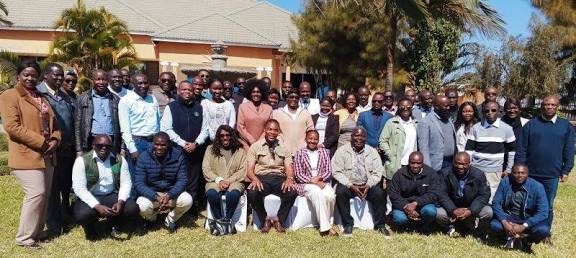
SIFAZ LEADS THE DISCUSSION ON SUSTAINABLE AGRICULTURE PRACTICES
, Claudio Bacigalupi (EU), Suze Filippini(FAO-R), John Mulongoti (PS Agriculture) and Dr. Peter Setimela (CIMMYT).jpg)
- Natasha Mhango
- 21 Jun, 2025
SIFAZ
LEADS THE DISCUSSION ON SUSTAINABLE AGRICULTURE PRACTICES
By
Natasha Mhango
The Sustainable Intensification of
Smallholder Farming Systems (SIFAZ) held a National Technical Symposium late
last month, which brought together specialists, technocrats and farmers from various
organizations and cooperations, to network and problem-solve issues related to sustainable
agriculture practices
SIFAZ, which is a program supported by
the European Union and led by the Food and Agriculture Organization (FAO) in
collaboration with CIMMYT and the Ministry of Agriculture; held its Symposium
under the theme "Advancing Food Security and Agribusiness Opportunities
for Smallholder Farmers through Sustainable Agriculture Innovations." The
event brought together stakeholders from various sectors to discuss ideas for enhancing
productivity and food security by promoting climate-smart agriculture practices
among smallholder farmers.
In his opening remarks, the Permanent
Secretary for the Ministry of Agriculture, John Mulongoti, emphasized the
importance of sustainable agriculture in ensuring food security and improving
the livelihoods of smallholder farmers. He noted that the Symposium provided a
crucial platform for stakeholders to share knowledge, experiences, and
innovations that could help address the challenges facing the agriculture
sector.
“Working with the coalition of United
Nations agencies and government, we are implementing best practices from
climate resilient initiatives to adapt the economy to climate change impact.
The goal is reach over 3 million beneficiaries in districts within selected
agro ecological regions which are vulnerable to climate change,” Mr. Mulongoti
revealed.
He acknowledged the progress being
made in promoting sustainable intensification practices among smallholder
farmers and assured participants at the Symposium that the government would
continue upscaling the good practices and lessons being implemented through
initiatives such as SIFAZ.
Mr. Mulongoti expressed gratitude to FAO
Zambia for organizing the Symposium and for continually complementing
government’s efforts to improve the agriculture sector.
In response to this, FAO Country Representative,
Ms Suze Percy Filippini, reaffirmed the organization's commitment to supporting
sustainable agriculture development in the country. She said that the Symposium
was a key step towards achieving SIFAZ's objectives of promoting climate-smart
agriculture, enhancing productivity, and improving food security among
smallholder farmers.
She explained that SIFAZ was a project
designed to respond to farmers’ and promote sustainable farming practices aimed
at enhancing the climate resilience of smallholder farmers.
Ms. Filippini added that SIFAZ had
recorded notable success in the last four farming seasons.
“Farmers supported by SIFAZ project
have demonstrated remarkable resilience by adopting intercropping practices
that integrate maize with leguminous crops and these include market-oriented
legumes like pigeon peas common beans, groundnuts and cow peas,” Ms. Filippini
said.
The Symposium featured a variety of
presentations from various experts on topics such as recommended sustainable
intensification practices that promote soil health, climate-smart farming
practices and agribusiness opportunities for smallholder farmers. The
presentations sparked discussions and debates among participants about the
challenges and opportunities in practicing sustainable intensification
practices.
One of the key takeaways from the Symposium
was the need to scale-up the adoption of sustainable intensification practices
among smallholder farmers. Key note speakers emphasized the need for
collaboration between government, private sector and civil society in
developing and promoting the adoption of sustainable agriculture innovations
among smallholder farmers.
Head of Cooperation at the European
Delegation to Zambia and COMESA, Claudio Bacigalupi, noted that farmers in
rural areas still grappled with the challenges of limited access to finance,
infrastructure, market inefficiencies and climate change.
“While strong policies are essential, it is
financing and investment that will drive real change on the ground. The lack of
access to affordable financing remains one of the most critical barriers to the
growth of smallholder farmers and agribusinesses,” Mr. Bacigalupi said.
He disclosed that the European Union
are supporting the SIFAZ programme with more than ZMK1.5 billion guided by the
goal to not only contributed to increased yields but to transform smallholder
farming into viable business enterprises.
“We must also work closely with the
private sector to create strong market linkages and develop value chains that
can support sustained investment in agribusiness development and this requires
robust partnerships with agro businesses, cooperatives and financial
institutions to ensure that financing reaches the farmers who needed it the
most,” he explained.
Based on his sentiments, it can be
agreed that the SIFAZ National Technical Symposium was a significant step
towards promoting sustainable agriculture development in the country, by
bringing together stakeholders from various sectors, to share knowledge,
experiences, and innovations that can help address the challenges such faced in
increasing productivity and boosting agribusiness.
The Symposium set the tone for productive
and engaging discussions that are necessary to promote the adoption of on
sustainable farming innovations and their potential to improve food security
and livelihoods among smallholder farmers.
.jpg)
Leave a Reply
Your email address will not be published. Required fields are marked *
BrentPep
Allow me to explain something most septic companies won't: there are two kinds of people in this world. Those who think septic systems are merely "underground boxes for waste," and those who have had raw sewage erupting into their property at the dead of night. I learned this difference the tough way in 2005—standing in sludge, trembling in a Washington downpour, as my family and I helped a veteran installer repair our family's collapsed system. I was a teenager. My hands blistered. My jeans were ruined. But that night, something crystallized: This isn't just digging. It's people's lives that we're safeguarding. Here's the ugly truth: nearly all septic companies just pump tanks. They are like quick-fix salesmen at a chainsaw convention. But Septic Solutions? They're special. It all originated back in the early 2000s when Art and his brothers—just kids scarcely tall enough to carry a shovel—assisted install their family's septic system alongside a experienced pro. Picture this: three youngsters buried in Pennsylvania clay, understanding how soil absorption affects drainage while their friends played Xbox. "We did not just dig holes," Art told me last winter, hot coffee cup in hand. "We learned how ground whispers truths. A patch of cattails here? That's Mother Nature shouting 'high water table.'" https://hive.blog/hive-178708/@praditya/the-progress
ArmandJalge
Here's the brutal truth: most HVAC failures occur because someone ignored a step. Failed to calculate the load properly. Used cheap equipment. Got wrong the insulation needs. We've personally fixed hundreds of these failures. And each time, we remember another insight. Like in 2017, when we decided on adding remote monitoring to all installation. Why? Because Sarah, our master tech, got frustrated of watching homeowners waste money on poor temperature settings. Now clients save hundreds yearly. https://www.producthunt.com/@productairheating
ArmandJalge
Here's the ugly truth: nearly all HVAC failures take place because someone skipped a step. Failed to calculate the load correctly. Used incorrect equipment. Got wrong the insulation needs. We have fixed dozens of these failures. And each time, we file away another learning. Like in 2017, when we decided on adding WiFi controls to each install. Why? Because Sarah, our senior tech, got tired of watching homeowners waste money on bad temperature management. Now clients save 20-30% yearly. https://community.cisco.com/t5/user/viewprofilepage/user-id/1951244
BrentPep
Let me explain something nearly all septic companies refuse to: there are two types of people in this reality. Those who think septic systems are simply "subterranean tanks for waste," and those that have had raw sewage gurgling into their property at midnight. I discovered this reality the difficult way in 2005—knee-deep in muck, trembling in a Washington rainstorm, as my family and I aided a weathered installer repair our family's collapsed system. I was fourteen. My hands were raw. My jeans were destroyed. But that evening, something clicked: This ain't just digging. It's families' lives we are preserving. Here's the dirty truth: most septic companies just pump tanks. They act like band-aid salesmen at a demolition convention. But Septic Solutions? They are special. It all began back in the beginning of the 2000s when Art and his siblings—just kids hardly tall enough to carry a shovel—assisted install their family's septic system alongside a grizzled pro. Imagine this: three youngsters buried in Pennsylvania clay, understanding how soil porosity affects drainage while their buddies played Xbox. "We didn't just dig trenches," Art shared with me last winter, steaming coffee cup in hand. "We learned how earth whispers secrets. A patch of marsh plants here? That's Mother Nature screaming 'high water table.'" https://www.keepandshare.com/discuss2/39026/random-backflow-during-heavy-showers
ArmandJalge
Here's the harsh truth: nearly all HVAC failures occur because someone skipped a step. Didn't calculate the load correctly. Used undersized equipment. Misjudged the insulation needs. We've personally fixed hundreds of these failures. And each time, we file away another insight. Like in 2017, when we decided on adding WiFi controls to each install. Why? Because Sarah, our master tech, got sick of watching homeowners burn money on bad temperature management. Now clients save hundreds yearly. https://openlibrary.org/people/productairheating/lists/OL317070L/Product_Air_Heating
Anya151sr
Hello everyone! I came across a 151 fantastic site that I think you should explore. This platform is packed with a lot of useful information that you might find valuable. It has everything you could possibly need, so be sure to give it a visit! <a href=https://soundsandcolours.com/subjects/travel/the-realities-of-latin-america-and-the-caribbean-78038/>https://soundsandcolours.com/subjects/travel/the-realities-of-latin-america-and-the-caribbean-78038/</a> And do not forget, everyone, which one constantly are able to inside the piece find answers to address your the very confusing questions. The authors tried — present all content using the extremely easy-to-grasp method.
ArmandJalge
Let me share the ugly truth: nearly all HVAC failures happen because someone ignored a step. Didn't calculate the load properly. Used cheap equipment. Misjudged the insulation needs. We've fixed dozens of these failures. And each and every time, we file away another insight. Like in 2017, when we decided on adding WiFi controls to each system. Why? Because Sarah, our lead tech, got frustrated of watching homeowners burn money on poor temperature control. Now clients save hundreds yearly. https://gitee.com/productairheating
CornellSlisp
Discovered vipdubaiagency.com while browsing premium retinue platforms. The site has a polished design, a extensive range of services, easy-to-understand pricing, and a smooth booking process. It feels more premium than most agencies I’ve encountered. Definitely recommended checking if you wish for comprehensive services in central platform. Visit: https://vipdubaiagency.com/
Cornellgoowl
Discovered vipdubaiagency.com while browsing premium entourage platforms. The site has a clean design, a impressive range of services, clear pricing, and a smooth booking process. It feels more high-class than most agencies I’ve encountered. Definitely recommended checking if you wish for full services in central platform. Visit- https://vipdubaiagency.com/
Stevensib
This is the brutal truth: the majority of HVAC failures take place because someone skipped a step. Did not calculate the load properly. Used undersized equipment. Got wrong the insulation needs. We've personally fixed hundreds of these messes. And each time, we remember another insight. Like in 2017, when we started adding remote monitoring to each system. Why? Because Sarah, our lead tech, got tired of watching homeowners waste money on poor temperature settings. Now clients save hundreds yearly. https://www.symbaloo.com/mix/bookmarks-4rjk
Search
Category