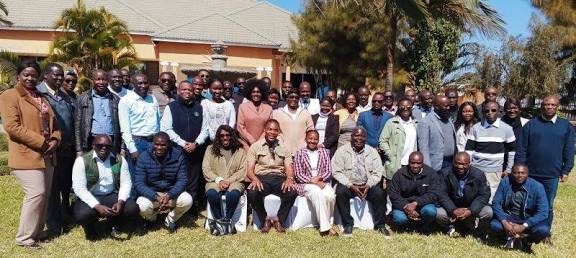
SIFAZ LEADS THE DISCUSSION ON SUSTAINABLE AGRICULTURE PRACTICES
, Claudio Bacigalupi (EU), Suze Filippini(FAO-R), John Mulongoti (PS Agriculture) and Dr. Peter Setimela (CIMMYT).jpg)
- Natasha Mhango
- 21 Jun, 2025
SIFAZ
LEADS THE DISCUSSION ON SUSTAINABLE AGRICULTURE PRACTICES
By
Natasha Mhango
The Sustainable Intensification of
Smallholder Farming Systems (SIFAZ) held a National Technical Symposium late
last month, which brought together specialists, technocrats and farmers from various
organizations and cooperations, to network and problem-solve issues related to sustainable
agriculture practices
SIFAZ, which is a program supported by
the European Union and led by the Food and Agriculture Organization (FAO) in
collaboration with CIMMYT and the Ministry of Agriculture; held its Symposium
under the theme "Advancing Food Security and Agribusiness Opportunities
for Smallholder Farmers through Sustainable Agriculture Innovations." The
event brought together stakeholders from various sectors to discuss ideas for enhancing
productivity and food security by promoting climate-smart agriculture practices
among smallholder farmers.
In his opening remarks, the Permanent
Secretary for the Ministry of Agriculture, John Mulongoti, emphasized the
importance of sustainable agriculture in ensuring food security and improving
the livelihoods of smallholder farmers. He noted that the Symposium provided a
crucial platform for stakeholders to share knowledge, experiences, and
innovations that could help address the challenges facing the agriculture
sector.
“Working with the coalition of United
Nations agencies and government, we are implementing best practices from
climate resilient initiatives to adapt the economy to climate change impact.
The goal is reach over 3 million beneficiaries in districts within selected
agro ecological regions which are vulnerable to climate change,” Mr. Mulongoti
revealed.
He acknowledged the progress being
made in promoting sustainable intensification practices among smallholder
farmers and assured participants at the Symposium that the government would
continue upscaling the good practices and lessons being implemented through
initiatives such as SIFAZ.
Mr. Mulongoti expressed gratitude to FAO
Zambia for organizing the Symposium and for continually complementing
government’s efforts to improve the agriculture sector.
In response to this, FAO Country Representative,
Ms Suze Percy Filippini, reaffirmed the organization's commitment to supporting
sustainable agriculture development in the country. She said that the Symposium
was a key step towards achieving SIFAZ's objectives of promoting climate-smart
agriculture, enhancing productivity, and improving food security among
smallholder farmers.
She explained that SIFAZ was a project
designed to respond to farmers’ and promote sustainable farming practices aimed
at enhancing the climate resilience of smallholder farmers.
Ms. Filippini added that SIFAZ had
recorded notable success in the last four farming seasons.
“Farmers supported by SIFAZ project
have demonstrated remarkable resilience by adopting intercropping practices
that integrate maize with leguminous crops and these include market-oriented
legumes like pigeon peas common beans, groundnuts and cow peas,” Ms. Filippini
said.
The Symposium featured a variety of
presentations from various experts on topics such as recommended sustainable
intensification practices that promote soil health, climate-smart farming
practices and agribusiness opportunities for smallholder farmers. The
presentations sparked discussions and debates among participants about the
challenges and opportunities in practicing sustainable intensification
practices.
One of the key takeaways from the Symposium
was the need to scale-up the adoption of sustainable intensification practices
among smallholder farmers. Key note speakers emphasized the need for
collaboration between government, private sector and civil society in
developing and promoting the adoption of sustainable agriculture innovations
among smallholder farmers.
Head of Cooperation at the European
Delegation to Zambia and COMESA, Claudio Bacigalupi, noted that farmers in
rural areas still grappled with the challenges of limited access to finance,
infrastructure, market inefficiencies and climate change.
“While strong policies are essential, it is
financing and investment that will drive real change on the ground. The lack of
access to affordable financing remains one of the most critical barriers to the
growth of smallholder farmers and agribusinesses,” Mr. Bacigalupi said.
He disclosed that the European Union
are supporting the SIFAZ programme with more than ZMK1.5 billion guided by the
goal to not only contributed to increased yields but to transform smallholder
farming into viable business enterprises.
“We must also work closely with the
private sector to create strong market linkages and develop value chains that
can support sustained investment in agribusiness development and this requires
robust partnerships with agro businesses, cooperatives and financial
institutions to ensure that financing reaches the farmers who needed it the
most,” he explained.
Based on his sentiments, it can be
agreed that the SIFAZ National Technical Symposium was a significant step
towards promoting sustainable agriculture development in the country, by
bringing together stakeholders from various sectors, to share knowledge,
experiences, and innovations that can help address the challenges such faced in
increasing productivity and boosting agribusiness.
The Symposium set the tone for productive
and engaging discussions that are necessary to promote the adoption of on
sustainable farming innovations and their potential to improve food security
and livelihoods among smallholder farmers.
.jpg)
Leave a Reply
Your email address will not be published. Required fields are marked *
gigaboomBoype
как узнать можно ли провести интернет по адресу краснодар <a href=https://podklyuchim-krd.site>podklyuchim-krd.site</a> провайдеры интернета по адресу
internetBoype
интернет по адресу <a href=https://podklyuchim-krd.site>podklyuchim-krd.site</a> как узнать какой провайдер в доме
internetBoype
проверка провайдера по адресу краснодар <a href=https://podklyuchim-krd.site>podklyuchim-krd.site</a> как проверить какие провайдеры есть в доме краснодар
Denniswat
Мягкая техника https://dolgoletmed.ru/uslugi/obertyvaniya/vodoroslevoe-obyortyvanie/vodoroslevoe-obyortyvanie-zhivota/ Применяется для снятия болей, поднятие мышечного тонуса, нормализуется состояние связок https://dolgoletmed.ru/uslugi/massazh/lechebnyj-massazh/lechebnyj-massazh-pri-gryzhe/ Массаж и мануальная терапия Поэтому у нас: МАНУАЛЬНАЯ ТЕРАПИЯ КОГДА НЕОБХОДИМО ПОСЕТИТЬ МАНУАЛЬНОГО ТЕРАПЕВТА? Мануальная терапия – комплекс техник и приемов, глубоко воздействующих на мышцы, суставы, костно-связочный аппарат https://dolgoletmed.ru/patsientam/golovnye-boli-v-visochnyh-oblastyah/
internetBoype
провайдеры по адресу дома краснодар <a href=https://kabelvkvartiru.space>kabelvkvartiru.space</a> узнать провайдера по адресу краснодар
gigaboomBoype
домашний интернет по адресу <a href=https://kabelvkvartiru.space>kabelvkvartiru.space</a> подключение к интернету краснодар
internetBoype
интернет провайдер краснодар <a href=https://kabelvkvartiru.space>kabelvkvartiru.space</a> домашний интернет по адресу краснодар
KodxDogPab
--- 1. "Is Sustainable Intensification Just a New Name for Colonial Agriculture?" If SIFAZ’s climate-smart innovations rely on Western-led tech (like CIMMYT’s seeds or EU funding), does it risk repeating the extractive patterns of past agricultural "aid"—where local knowledge is sidelined, and Zambia’s sovereignty over its food systems is eroded? Or is this the first time "sustainability" means real power-sharing? --- 2. "What If Zambia’s Farmers Don’t Want to Be ‘Smarter’—What If They Want to Be Free?" SIFAZ frames smallholders as "needing" climate-smart tech to survive, but what if their resistance isn’t ignorance—what if it’s a refusal of dependency? How do you market "sustainable intensification" without implying that traditional methods are inherently "unsustainable" or "backward"? --- 3. "Could SIFAZ’s Success Be Measured by How Many Farmers It Doesn’t Reach?" If the program’s real breakthrough is proving that some smallholders can adopt high-tech farming, does that mean the system is failing the majority? Or is the goal to create a two-tiered agriculture—where a "smart elite" lifts Zambia’s profile, while the rest cling to "low-productivity" subsistence? --- 4. "Who Gets to Define ‘Climate-Smart’? The EU, FAO, or the Farmers Who’ll Burn Their Fields to Keep Cool?" When SIFAZ promotes "low-emission" practices, does it account for the fact that many Zambian farmers already are climate-smart—by burning fallow lands to clear weeds, or rotating crops to avoid soil depletion? Are these "traditional" methods just "unregulated" climate solutions? --- 5. "Is the Future of Zambian Agriculture a Tech Utopia… or a Corporate Feast?" With CIMMYT’s seed patents and EU-backed agribusiness ties, could SIFAZ’s innovations end up funneling profits to multinational seed companies while Zambian farmers become perpetual licensees? Or is this the price of "modernization"? --- 6. "What If the Real Climate Solution Isn’t More Farming—But Fewer People Farming?" SIFAZ’s focus on intensification assumes Zambia’s population will keep growing indefinitely. But what if the real climate-smart move is reducing agricultural pressure by shifting labor to non-farm sectors? Is that a radical idea—or just a taboo one? --- 7. "Could SIFAZ’s ‘Innovations’ Be a Trojan Horse for Land Grabs?" By promoting high-yield techniques, does the program inadvertently justify large-scale commercial farms taking over smallholder land—under the guise of "scaling up" sustainable models? Or is this paranoia, given the program’s explicit focus on smallholders? --- 8. "Why Does ‘Sustainable’ Always Mean ‘More Work’ for Zambian Women?" If climate-smart farming requires more labor (e.g., precision irrigation, crop monitoring), who picks up the slack? Are women’s unpaid labor and time already factored into "sustainable intensification," or is this just another way to exploit their labor under a greenwashed banner? --- 9. "What If the Best Climate Solution Isn’t a Seed or a Drip Irrigation System—But a Ban on Zambian Farmers Growing Cash Crops?" With global demand driving deforestation (e.g., for soy or palm oil), could SIFAZ’s real climate win be convincing Zambian farmers to stop growing export crops—and instead focus on food sovereignty? Is that a heretical thought? --- 10. "Is SIFAZ’s Success Measured in Tons of Maize… or in How Many Farmers Still Have Land?" If the program’s metrics only track yield increases, does it ignore the fact that intensification often leads to land concentration? Could Zambia end up with "more food" but fewer smallholders—just like the Green Revolution? --- 11. "What If the ‘Smallholder’ in SIFAZ Isn’t a Farmer—But a Failed Commercial Farmer?" Many "smallholders" in Zambia are actually former large-scale farmers who lost land to debt or corruption. Does SIFAZ risk pathologizing them as "inefficient" while ignoring the systemic forces that made them smallholders in the first place? --- 12. "Could SIFAZ’s Climate-Smart Farming Be the New Apartheid—Where Some Get Tech, Others Get Drought?" If only certain regions or farmers can access SIFAZ’s innovations (due to funding gaps or infrastructure), does that create a new kind of agricultural segregationhttps://kodx.uk/ ] <a href=http://hidrossol.com/how-to-keep-your-office-spotless-year-round/#comment-4355>#gpt_question_subject<>Soluções profissionais de TI para sua empresa ]</a> 21c69c3
internetBoype
какие провайдеры есть в доме краснодар <a href=https://poadresu-krd.online>poadresu-krd.online</a> тарифы домашнего интернета
internetBoype
узнать провайдеров интернета по адресу <a href=https://poadresu-krd.online>poadresu-krd.online</a> подключить домашний интернет по адресу краснодар
Search
Category